


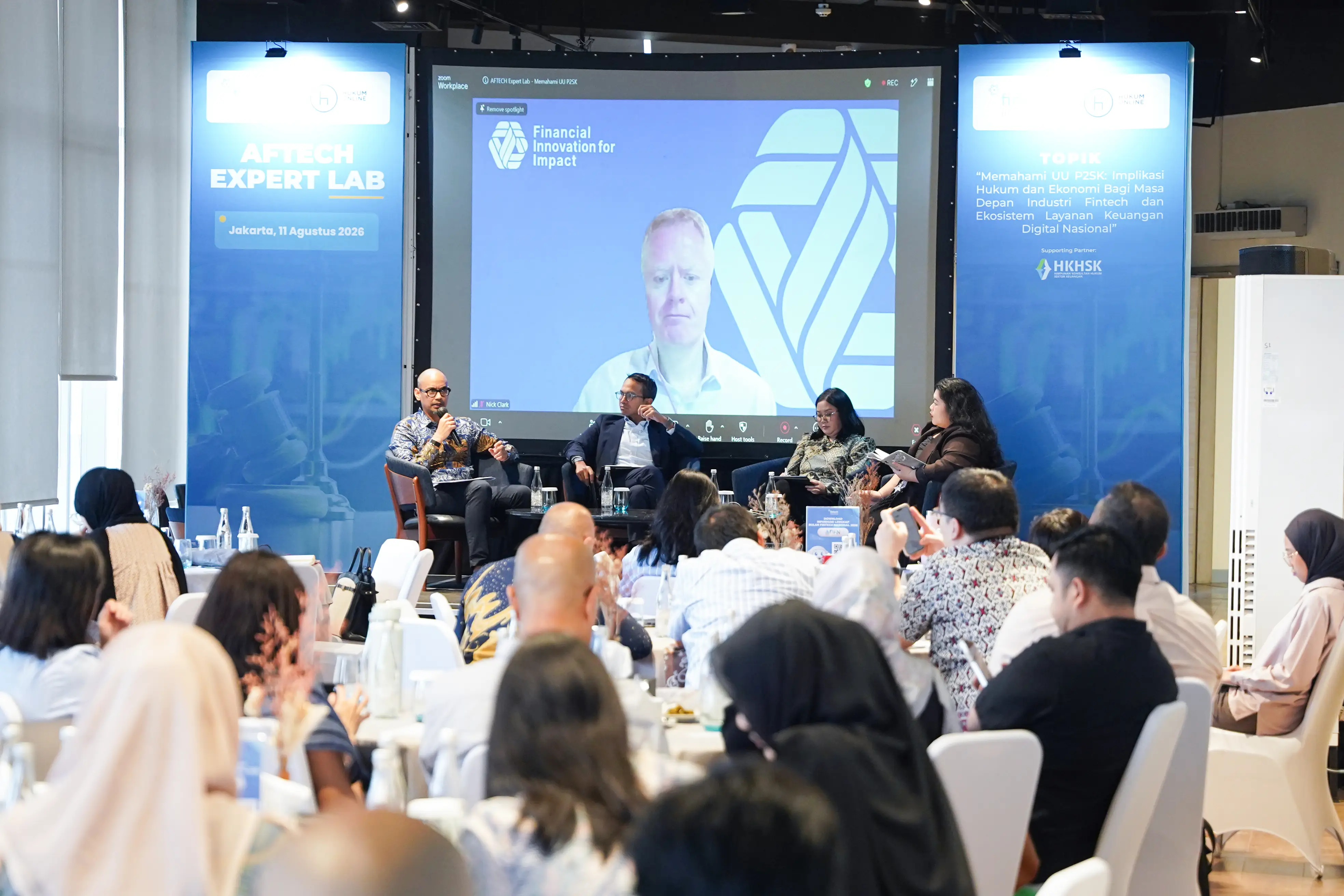
Jakarta, 11 August 2026 – The Indonesian Fintech Association (AFTECH), in collaboration with Hukumonline and HKSK, convened the AFTECH Expert Lab: In-Depth Discussion on the Implications of the P2SK Law for the Fintech Industry. The forum provided a platform for industry stakeholders to deepen their understanding of regulatory developments and their implications for fintech business models and the broader fintech ecosystem in Indonesia.
The discussion brought together legal, economic, international regulatory, and industry perspectives. Key topics included business classification and licensing, compliance costs, supervision and consumer protection, digital financial assets, universal banking, as well as emerging opportunities for collaboration and innovation.
Changes introduced under the P2SK Law may have different implications for each fintech business model. Their impact extends beyond compliance requirements, influencing investment decisions, product development, partnerships, and broader business strategies.
An internal AFTECH survey involving 40 companies across nine fintech business categories found that 78% of respondents considered themselves sufficiently familiar with the substance of the P2SK Law. However, most respondents had yet to complete a specific assessment of how the law would affect their respective business models. This indicates that understanding the substance of a regulation does not necessarily mean that its full implications for business operations have been identified.
Business classification emerged as one of the most material areas of concern, as it directly affects licensing, supervision, governance, compliance obligations, and overall cost structures.
The discussion also highlighted that the impact may vary depending on company size. Higher compliance costs, particularly those that function as fixed costs, may place a proportionately greater burden on smaller fintech companies. Regulatory implementation should therefore take into account the characteristics and risk profiles of different business models while maintaining the objectives of effective supervision and consumer protection.
While the P2SK Law requires a range of adjustments from the industry, it also creates new opportunities.
The concept of universal banking, for example, could create broader opportunities for collaboration between banks and fintech companies. The discussion highlighted that the relationship between the two sectors does not necessarily need to evolve through direct competition, but could increasingly develop through complementary partnerships.
Opportunities may also emerge through Alternative Credit Assessment (Penilaian Kredit Alternatif/PKA or Innovative Credit Scoring) and the continued development of Digital Financial Assets (Aset Keuangan Digital/AKD). The P2SK Law therefore presents two dimensions that need to be considered simultaneously: compliance impact and business opportunity.
At the same time, emerging business models, such as asset tokenization and services combining crypto assets with lending activities, require further regulatory attention. As these models continue to evolve, implementing regulations will need to provide sufficient clarity while preserving room for responsible innovation.
From the industry’s perspective, AFTECH identified three key priorities for the implementation of the P2SK Law: clarity, certainty, and continuous dialogue.
Clarity is essential to help industry players understand the applicable business classifications, the relevant supervisory authorities, and the obligations associated with their respective business models. Certainty is equally important, particularly regarding the timeline for implementing regulations and transitional periods, so companies have adequate time to adjust their systems, contracts, operations, and ongoing investments.
Meanwhile, continuous dialogue is increasingly important, particularly in addressing emerging business models that are not yet fully accommodated within existing regulatory frameworks. These priorities are not intended to reduce regulatory oversight, but rather to ensure that regulations can be effectively complied with while preserving space for innovation.
The AFTECH Expert Lab also placed consumer protection at the heart of the discussion on regulatory implementation. Strengthening the fintech industry must go hand in hand with sound governance, financial sector stability, and effective protection for consumers.
In this context, a proportionate regulatory approach does not mean lighter regulation. Rather, it means regulation that is well-targeted and risk-based, enabling supervisory objectives to be achieved without creating unnecessary barriers to investment and innovation.
The forum also addressed the importance of coordination among regulators, particularly for business models whose activities may fall under more than one regulatory framework. Greater clarity in this area is becoming increasingly important as digital financial services continue to integrate multiple features and activities within a single ecosystem.
Through the Expert Lab, AFTECH reaffirmed its commitment to serving as a thought partner for government, regulators, and industry stakeholders in supporting the transformation of Indonesia’s financial sector.
Going forward, AFTECH will continue to encourage active industry participation in discussions on implementing regulations, provide regulators with data-driven input, and support the development of a national fintech roadmaptogether with the government and relevant stakeholders.
The implementation of the P2SK Law represents an important milestone for Indonesia’s fintech industry. As fintech becomes increasingly integrated into the national financial sector, the success of this transformation will depend on stakeholders’ ability to maintain an appropriate balance between regulatory certainty, innovation, stability, consumer protection, and industry competitiveness.
Through open dialogue and sustained collaboration, AFTECH aims to support the implementation of the P2SK Law as a strong foundation for a healthier, more innovative, inclusive, competitive, and sustainable fintech ecosystem in Indonesia.


